


In addition to the partnership with 247Venture, Verji Tech AS also announces the signing of a significant distribution agreement with 24SevenOffice.
A company can have a detailed privacy policy, access-controlled systems and regular security training, and still struggle with what happens to personal information during a normal working day. Someone needs a payroll document. A client has a question about a tax return. An auditor requests a sensitive file. A colleague needs to review a draft before it goes out.
None of these situations is unusual. They are precisely the routines in which data protection should work with the least friction. Yet the distance between the formal policy and the actual communication workflow is often where avoidable exposure begins.
Compliance is more than having the right documents
The GDPR is not a checklist that an organisation completes once. It requires an ongoing approach to protecting personal data, including appropriate organisational and technical safeguards that reflect the nature and risks of the processing involved. Policies, access rights and training form part of this foundation. But an important additional question is whether employees can consistently apply those safeguards while completing ordinary tasks.
Consider how a sensitive document may travel. It starts inside a controlled business system. Someone exports it, emails it to an external contact and perhaps sends a password by another route. The recipient then replies with questions and additional personal information through ordinary email. The organisation may have secured the original file, but the wider exchange is fragmented.
The problem is not always a lack of intent. Often the approved route is slower or harder than the familiar one. If the secure process depends on constant reminders, manual steps and repeated explanations to clients, workarounds become more likely.
What it means to make compliance operational
Operational compliance means designing everyday workflows so that people can carry out legitimate business tasks without repeatedly having to invent their own protection measures. In communication, that translates into a few practical principles.
Protect the full exchange. A secure outbound document is only part of the picture. Questions, replies and subsequent files need appropriate protection too.
Use channels people can actually adopt. A tool that customers find confusing may drive conversations back to email. Usability is therefore relevant to consistent security practice.
Control access around the work. Colleagues should be able to participate, when necessary, without scattering the same sensitive thread across multiple personal inboxes.
Reduce manual workarounds. Repeated PDF encryption, password distribution and physical handoffs can consume time and introduce mistakes.
Keep accountability visible. Clear workflows help organisations understand who should see information and how sensitive exchanges are handled.
An anonymised example: an accounting firm changes its client workflow
Illustrative composite example informed by patterns in published Verji customer stories. It is not a verbatim account of one customer; no figures or outcomes are attributed to an anonymous organisation.
Imagine a small accounting firm supporting several hundred clients, including businesses with payroll and other personal data requirements. Its staff follow internal security rules and use accounting software with role-based access. But their communication process is harder to control.
When a client needs a document, an employee exports it as an encrypted PDF and delivers the password separately. Some clients struggle to open the file. Others reply to the original email with questions, identity information or updated bank details. Staff then search individual inboxes to reconstruct decisions, while a senior colleague may need to be forwarded parts of a conversation to help resolve an issue.
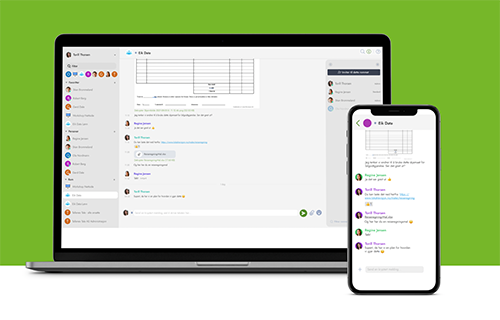
The firm decides to change the communication workflow rather than simply issue another reminder about sensitive email. It introduces dedicated secure client conversations for documents, questions and follow-ups. Team members with a legitimate reason to participate can be included in the relevant space, so the dialogue remains connected to the work.
For a client, the experience becomes simpler: open the message, review the document and reply in the same secure environment. For staff, it removes repetitive password handling and makes it easier to bring in a supervisor without forwarding confidential threads around the organisation.
This is not evidence that every risk disappears, nor that adopting a single platform fulfils all GDPR obligations. It is an illustration of what changes when security is designed into the process instead of added as a separate step.
Real customer experiences point in the same direction
The pattern is visible in Verji’s published customer stories. Tidy Account has described moving away from encrypted PDFs and using Rooms to support visibility and collaboration. Vestlandsrevisjon has explained how encrypted communication enabled sensitive audit documentation to be exchanged electronically instead of being physically delivered. Viego Regnskap has emphasised that clients could adopt secure communication without significant difficulty.
The details differ, but the direction is consistent: when a secure channel fits the workflow, organisations can reduce the gap between how information should be handled and how it is actually exchanged.
Five questions to ask about your current communication workflow
- When a confidential document is shared, how does the recipient reply?
- Could sensitive information end up in an unintended inbox or forwarded thread?
- How many manual steps must employees and clients complete to exchange a file securely?
- Can the right colleagues assist with a sensitive client matter without copying messages into multiple channels?
- Is the approved process simple enough to remain the default on a busy day?
Where Verji fits
Verji is built for organisations that need to exchange confidential information as part of ordinary work. Encrypted messaging, file sharing and collaborative Rooms offer a dedicated environment for communicating with colleagues, clients and external parties, helping reduce reliance on fragmented email and ad hoc file-sharing methods.
The aim is not to replace the wider privacy programme. It is to make one high-frequency part of that programme—everyday communication—more consistent and manageable.
From good intentions to repeatable habits
Data protection is strongest when policies, people and technology support one another. A sound policy sets expectations. Training explains why they matter. And well-designed workflows make those expectations practical to follow.
For organisations handling personal information every day, the useful question may be simple: if the safe way of communicating takes extra effort, what would it take to make it the easiest way?